The current logo (above), launched 2025, honors the original logo (left), which was closely associated with the Kamayan Restaurant, a former partner of the forum, and served as a symbol of the forum’s long-traced roots and community-based discourse.
Kamayan was established by its founding fathers, Vic Milan, Ding Reyes, and Vicvic Villavicencio, out of the need to mainstream environmental issues to the public, using open dialogue as a means to engage citizens, experts, and advocates in environmental discourse.
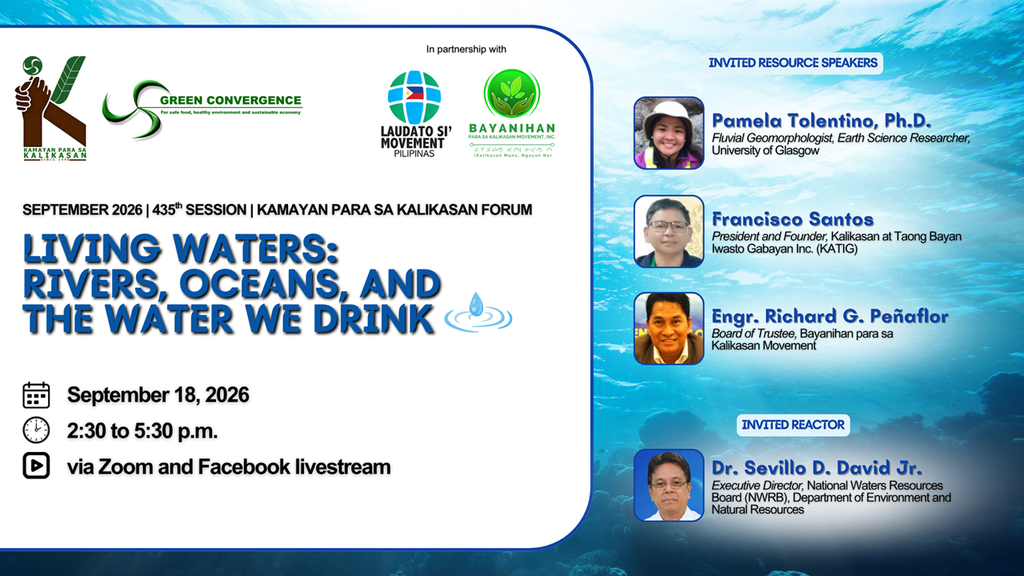
Living Waters: September 2026 Kamayan Forum examines the interconnectedness of river, ocean, and drinking water health
In observance of the Season of Creation and World Water Monitoring Day, Green Convergence (GC), together with Laudato Si’ Movement Pilipinas and Bayanihan Para Sa Kalikasan Movement, held the 435th Kamayan Para Sa Kalikasan forum with the theme “Living Waters: Rivers, Oceans, and the Water We Drink” on September 18, 2026, via Zoom and Facebook livestream.
The forum examined the changing conditions of Philippine rivers, oceans, and drinking water amid climate change, marine pollution, and coral reef degradation, while bringing together perspectives on the challenges facing these water systems and possible ways to address them.
Opening the forum, Sr. Elizabeth “Bing” Carranza, Chapter Coordinator of Laudato Si’ Movement Pilipinas, situated the discussion within the 2026 Season of Creation theme, “Immersion in Living Water,” or simply “Living Water.”
Carranza described the Season of Creation as an annual celebration when the ecumenical family comes together to respond to the “cry of creation” and care for Earth as a common home.
She also reflected on the close relationship between water and life, noting that the human body itself is largely composed of water.
“The living waters that we all are will spontaneously flow like rivers of love, justice, joy, peace, and healing,” Carranza said.
The discussion then turned to rivers, with Dr. Pamela “Pammie” Tolentino, a Fluvial Geomorphologist and Earth Science Researcher, presenting “Living Rivers, Thriving Communities: Nature-based Solutions Grounded on Geomorphic Principles for the People.”
Tolentino described rivers as dynamic systems that support water supply, livelihoods, communities, and the landscapes people call home.
“A healthy river is not just an environmental asset; it is the foundation of a thriving society,” she said, calling for a shift from trying to control rivers toward understanding and working with their natural processes.
She explained that rivers naturally move, flood, erode, and transport sediment, while interventions that fail to account for these processes can create impacts beyond the immediate project area.
“Rivers are not problems to be fixed. They are living systems to be understood and worked with,” Tolentino said, emphasizing the need to consider each river’s characteristics and its wider catchment.
She also underscored the role of communities living alongside rivers, whose local knowledge and daily experience can contribute to river management.
For Tolentino, effective management requires science, long-term planning, coordination across administrative boundaries, and meaningful community participation. She ended with a call to ‘let the river speak’ and allow rivers to live so communities may thrive.
The discussion then moved to coastal ecosystems, with Francisco Santos, President and Founder of Kalikasan at Taong Bayan Iwasto Gabayan Inc. (KATIG), presenting “Caring for the Living Oceans: Mangrove Restoration.”
Santos described mangroves as a first line of defense for coastal communities, highlighting their roles in protecting coastlines, absorbing carbon, and providing habitat.
“Ang kahalagahan nga po ng bakawan sa ating katubigan, partikular sa dagat at ilog, sila kasi ang tinatawag naming first line of defense,” Santos said.
He identified deforestation, urbanization, land-use changes, climate change, and limited public awareness among the challenges facing mangrove ecosystems.
Santos also discussed Manila Bay’s geographical conditions and seasonal water movements, particularly in relation to reclamation and mangrove areas.
He explained how changes to coastal landscapes can affect the movement of water and the conditions needed for mangrove ecosystems to develop, underscoring the need to understand these natural processes when planning interventions.
Santos also emphasized that protecting mangroves begins with making communities aware of their role in safeguarding coastal ecosystems. “Kung kulang ang awareness ng tao, ng komunidad, walang partisipasyon, paano protektahan ang ating katubigan, ang ating mga halaman?” he said.
The forum then shifted from ecosystems to the water people consume every day as Engr. Richard Peñaflor, Board of Trustees of Bayanihan Para Sa Kalikasan Movement Inc., presented “The Living Water We Drink: Every Drop is Precious.”
“When we drink a glass of water, we are not merely drinking water—we are drinking the health of our watershed, the efficiency of our infrastructure, the quality of our governance, and the future of our environment,” Peñaflor said.
Peñaflor stressed that water availability does not automatically mean water security, which also depends on infrastructure, maintenance, accessibility, and the condition of the ecosystems that sustain water resources.
He discussed five dimensions of water security, such as rural household, economic, urban, environmental, and water-related disaster security, which he connected to pressures facing the Philippines, including pollution, watershed degradation, groundwater depletion, urbanization, climate change, inequality, and water losses.
Peñaflor called for action at the individual, community, and government levels, from fixing household leaks and protecting local water sources to strengthening watershed protection, water-quality monitoring, wastewater treatment, and equitable access to water.
Reacting to the three discussions, Dr. Sevillo “Bill” David Jr., Executive Director of the National Water Resources Board (NWRB), Department of Environment and Natural Resources, tied the discussions together through integrated water resource management.
“Water is not merely a resource. Water is a living system. Because it is living, the governance, from top to bottom governance, must also be living, adaptive, and of course, interconnected,” David said.
David described rivers as part of a larger system connecting upland, lowland, and coastal areas, or “ridge to reef,” and emphasized the need for scientific and evidence-based planning, data-driven monitoring, and coordination among national agencies, local government units, and communities.
He also highlighted mangroves as natural infrastructure and said ecosystem-based approaches should form part of water security planning, particularly as climate change intensifies.
“The health of our rivers or oceans, including coastal areas, cannot be separated from the health of our communities,” David said, calling for solutions that are science- or evidence-based, participatory, and anchored on equity.
The open forum brought the discussion closer to everyday concerns, including the safety of tap and refilled water, water tariffs, rural access, deep wells, and the condition of aquifers.
Preparations for the anticipated Super El Niño were also raised, with discussions covering water conservation, rainwater and floodwater storage, locally appropriate measures, agricultural preparations, and information campaigns.
The discussion underscored the need for coordination among government agencies, local communities, civil society, water providers, and other sectors in preparing for water-related challenges.
Closing the forum, Victoria Segovia, President of GC, returned to the central idea of the gathering that water connects ecosystems, communities, and the lives that depend on them.
“Water is life. And the theme for Season of Creation 2026 is ‘Living Water,’ for water is a sacred gift from the Creator that quenches our thirsts, nourishes the earth, and heals the wounds,” Segovia said.
She ended by emphasizing the interconnectedness of rivers, oceans, ecosystems, and communities, saying, “Living water means standing together so that our ecosystems and the life they sustain can continue to flourish.”
The next Kamayan forum was announced to be on October 16, 2026.
Kamayan Para Sa Kalikasan is a monthly initiative organized by Green Convergence that enables non-government organizations, government representatives, the media, students, teachers, church groups, and concerned citizens to discuss, analyze, and create solutions to pressing environmental issues in the country.
For those interested in being a member of Green Convergence, visit this link to register: bit.ly/GCMembershipRegForm.
#GreenConvergence #KamayanParaSaKalikasan #LivingWater #SeasonOfCreation2026 #LivingWaters #Rivers #Oceans #Water
Partner Organizations in Our Kamayan Sessions